
myWeberHaus: Why customer portals in house construction need to offer more today

Every good idea needs the right timing. When WeberHaus and PROPSTER first started talking in 2018, WeberHaus was in the process of further developing its own customer portal, "myWeberHaus," and was looking for a suitable sample selection platform. At that time, the technical and procedural requirements didn't quite align. A few years later, this very open thread led back to the same table.
With the relaunch of myWeberHaus at the beginning of 2025, the renewed exchange became a joint project: WeberHaus's digital customer experience was placed on a new technological foundation, based on the PROPSTER customer management platform.
For WeberHaus, this is more than just a technical update. The prefabricated home manufacturer has been using a customer portal since 2014, demonstrating how early the company recognized that customer centricity in home construction isn't solely achieved through personal interaction. Anyone who guides people through one of the biggest projects of their lives must also provide digital guidance, transparency, and reliability: from the initial inspiration through the construction phase to after-sales service.
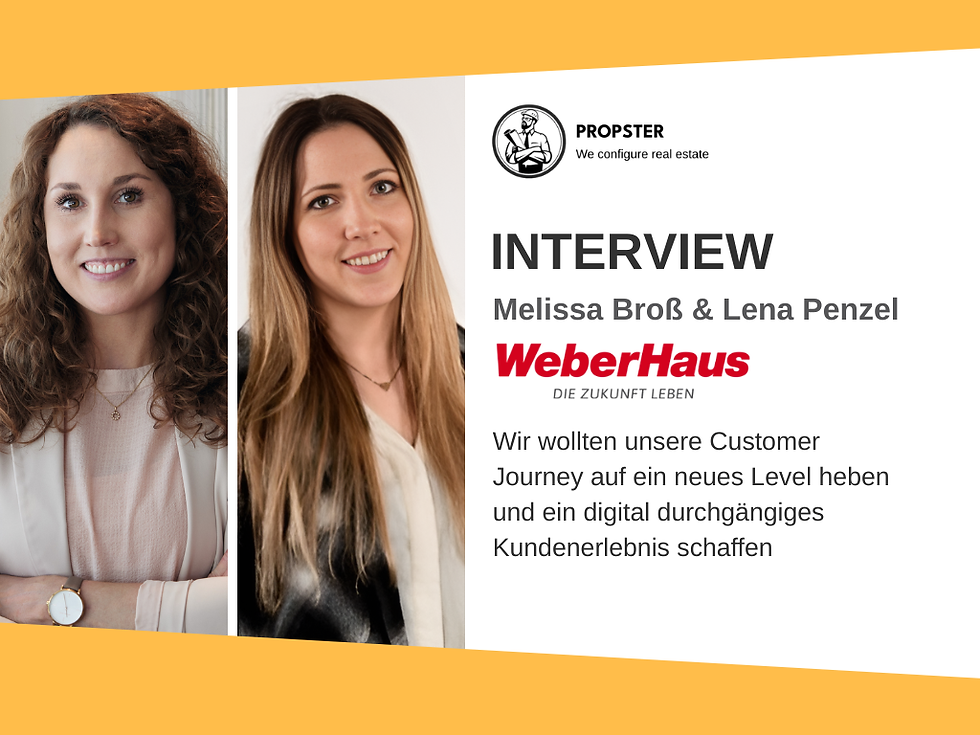
Our colleague from marketing, Aleks Gavric, spoke with Lena Penzel, CRM manager at WeberHaus, and Melissa Broß from Strategic Corporate Development about the relaunch of myWeberHaus, the role of PROPSTER, and how a customer portal now accompanies prospective customers, builders, and homeowners along the entire customer journey.
A quick question about you: What is your professional background? What is your professional role at WeberHaus, and what areas of responsibility do you have?
Lena Penzel : I am a CRM Manager at WeberHaus and responsible for the maintenance and further development of the customer portal, marketing automation, and primarily project management and customer service projects. Melissa Broß : My name is Melissa Broß. I work in Strategic Business Development at WeberHaus, focusing on product and customer journey.
How did you first become aware of PROPSTER and what factors led to its introduction?
Our initial contact with PROPSTER dates back to 2018. At that time, we had just launched our customer portal and were looking for a suitable sample platform. Technical and procedural differences meant we didn't reconnect until five years later – with the relaunch of our customer portal, myWeberHaus. PROPSTER offers us a technically standardized yet flexible platform that perfectly suits the customer journey at WeberHaus. For us, the high-quality user experience and the seamless integration into our processes, including connection to our CRM system, were key reasons for this joint project. Last but not least, we clicked on a personal level from the very beginning, which is essential for a long-term, collaborative partnership.
What was the main trigger for the relaunch of myWeberHaus at the beginning of 2025, and thus also the main trigger for using PROPSTER? What specific problem did you solve with it?
We wanted to take our customer journey to a new level and create a seamless digital customer experience that optimally supports our clients through every phase of the construction process – from the initial inspiration gathering through the construction phase to after-sales service. This creates greater project transparency and faster communication, both externally and internally.
How did the platform's implementation proceed from an organizational perspective? Was there a pilot phase or a gradual integration across multiple projects?
The platform was rolled out gradually across several sub-projects. Initially, we focused on launching the core features and expanded upon them in two further sub-projects to offer our users a comprehensive platform. Currently, we are expanding the service area for our homeowners to enable them to quickly and efficiently record service or renovation requests and route them to our internal teams.
What were the 2-3 most important goals for the relaunch of myWeberHaus, for example, fewer inquiries, faster communication, fewer errors, or a better customer experience?
In every project we undertake, we adhere to our founder's company philosophy : "Building should be a joy" —not only for ourselves, but above all for our clients. Therefore, the primary goal of our myWeberHaus relaunch was to continuously improve the digital customer experience and customer communication. Naturally, we also aimed for simplified communication to make internal processes more transparent and efficient.
How did customer communication and document/appointment handling work before the myWeberHaus customer portal? What were the top 3 pain points?
Customer communication has primarily taken place directly via telephone or email. These channels remain the preferred methods for quickly and thoroughly addressing customer concerns. However, due to work commitments, our customers are often difficult to reach by phone during the day. Therefore, a digital solution is essential to ensure that communication and service requests are documented and accessible to other colleagues. This is particularly important in cases of staff absence, such as during vacations. While digital documents, such as shop drawings and electrical plans, have previously been sent via email, our customer portal allows these documents to be stored centrally and updated as needed. This gives our users access to their building files at any time, and our colleagues can ensure that the documents are always up to date.
How do your customers use myWeberHaus today, depending on their user status (i.e., prospective buyer, builder, and homeowner), and how do the individual statuses differ?
Generally, communication with WeberHaus contacts, appointment overviews, and quick access to one's own house building project, including all documents, are central to user behavior. For prospective customers (i.e., leads before contract signing), myWeberHaus is primarily used for gathering inspiration and defining building preferences, accessing the digital magazine, and for pre-qualifying candidates in preparation for a meeting with our building consultants. Once a homeowner has signed a contract (until handover of the house), user behavior changes, and the focus shifts to project management – specifically, access to all relevant dates and documents. Our recently launched customer benefits program, myWeberHaus Benefits, is very popular with this user. Our homeowners (customers after handover of the house) primarily use myWeberHaus for customer service inquiries and to access myWeberHaus Benefits.
Which functions are most frequently used in each user status, i.e., by prospective buyers, builders, and homeowners?
For prospective customers, the digital magazine is used most frequently. For those already building a home, myWeberHaus benefits and document management are the primary features. And for homeowners, myWeberHaus benefits, service requests, and document management are the main focus.
If you had to summarize the success after introducing a customer portal in three key figures or results, what would they be?
The most important results are customer satisfaction, customer loyalty or NPS, and user numbers: +72% unique users compared to the year of launch.
In which user status – prospective buyer, builder, or homeowner – would a 24/7 AI agent like PAULA have the greatest impact, and which two KPIs would you use to measure success?
From an internal perspective, the greatest leverage lies in the status of building owner and homeowner: By having an AI agent handle typical inquiries, colleagues can be relieved of some of their workload. Suitable metrics for measuring success include the processing time of the inquiry and the number of inquiries handled per project manager. From the customer's perspective, the greatest leverage lies in the status of homeowner: An AI agent could resolve simple service inquiries more quickly. A relevant metric here would be the processing time of the service request.
In conclusion: If you had to explain to a colleague in one sentence why myWeberHaus makes everyday life easier, what would you say and what specific example would you give?
For customers, myWeberHaus means having their own house building project digitally "in their pocket." For WeberHaus employees, it primarily means transparency through a digital building file, including communication.
Did you enjoy this article? Then download the free success story from myWeberHaus now and let's talk afterwards! --> Download the Success Story

